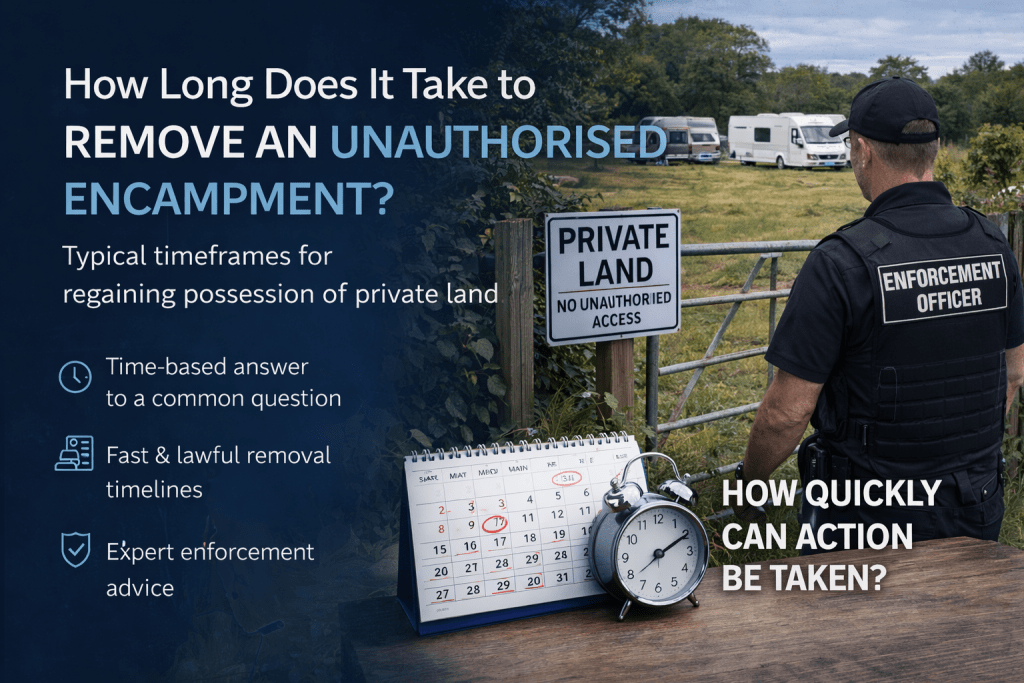
When travellers or trespassers occupy private land without permission, one of the first questions landowners ask is how long it will take to resolve the situation.
The reality is that timeframes can vary depending on several factors, including the size of the encampment, the legal route used and how quickly action is taken. However, understanding the process and acting early can significantly reduce delays.
At West Country Bailiffs, we work with landowners across the South West and nationwide to remove unauthorised encampments efficiently, using the most appropriate legal approach for each situation.
Why Timing Is Critical
When dealing with unauthorised occupation, speed plays a major role in the outcome.
The longer an encampment remains in place, the greater the risk of:
- Additional vehicles arriving
- Waste accumulation
- Damage to land or access points
- Disruption to business or development activity
Early action not only improves the chances of a faster resolution, but it also reduces overall cost and risk.
Typical Timeframes for Removal
There is no single fixed timeframe, but most situations fall into one of the following categories.
Voluntary Departure
In many cases, when enforcement officers attend promptly and engage professionally, occupants may choose to leave voluntarily.
This can happen within:
- The same day
- 24 to 48 hours
Clear communication and visible enforcement presence often encourage a quick resolution without the need for court proceedings.
Common Law Eviction
Where appropriate, common law rights may allow landowners to take direct action to recover possession.
This route can often be completed within a short timeframe, provided it is handled correctly and without escalation.
However, it must always be carried out lawfully and with professional oversight.
Possession Proceedings (Part 55)
Where court action is required, possession proceedings provide a structured and legally robust solution.
This route involves:
- Issuing a court claim
- Serving notice on occupants
- Attending a hearing
- Enforcing the possession order if required
While this process takes longer than voluntary departure, it provides clear legal authority and is often necessary in more complex situations.
What Affects the Speed of Removal?
Several factors influence how quickly an unauthorised encampment can be removed.
Size of the Encampment
Larger encampments with multiple vehicles can take longer to resolve, particularly if additional legal steps are required.
Cooperation of Occupants
If occupants leave voluntarily after being approached by enforcement officers, the process is significantly faster.
If they refuse to leave, legal enforcement becomes necessary.
Legal Route Chosen
Different legal options have different timelines.
Choosing the correct route from the outset is essential to avoid unnecessary delay.
For a full breakdown of available legal options, see our guide on how to remove travellers from private land quickly and lawfully.
Speed of Initial Response
One of the biggest factors is how quickly the landowner takes action.
Delays of even a few days can allow the situation to escalate, making removal more complex and time consuming.
Site Conditions and Access
Difficult access points, rural locations or restricted entry areas can also influence how the situation is managed and resolved.
Why Early Professional Involvement Matters
Engaging enforcement specialists at the earliest stage often leads to faster outcomes.
Professional enforcement teams can:
- Attend site quickly
- Assess the situation
- Choose the correct legal route
- Communicate clearly with occupants
- Prevent escalation
In many cases, early intervention results in voluntary departure, avoiding the need for longer legal processes.
Minimising Delays and Disruption
Landowners can take simple steps to reduce delays when an encampment appears.
These include:
- Seeking advice immediately
- Avoiding confrontation
- Documenting the situation
- Acting decisively
- Following professional guidance
A structured and lawful approach leads to more efficient resolution.
What Happens After Removal?
Once the encampment has been cleared, attention should turn to preventing future occupation.
Common preventative measures include:
- Installing secure gates
- Blocking vulnerable access points
- Using barriers or deterrents
- Carrying out regular inspections
Sites that are clearly managed are less likely to be targeted again.
A Realistic Expectation
While some encampments can be resolved within a day or two, others may require formal legal action and take longer.
The key takeaway is this:
The sooner action is taken, the faster the outcome is likely to be.
Professional Support You Can Rely On
At West Country Bailiffs, we have over 30 years of experience helping landowners deal with unauthorised encampments across rural and commercial environments.
We assess each situation individually and implement the most effective strategy to remove travellers from private land as quickly and lawfully as possible.
Take Action Early
If travellers have occupied your land, do not wait.
Delays increase risk, cost and disruption. Early professional intervention is the most effective way to achieve a fast and controlled resolution.
Contact West Country Bailiffs for clear advice and immediate support in removing unauthorised encampments and restoring control of your land.