
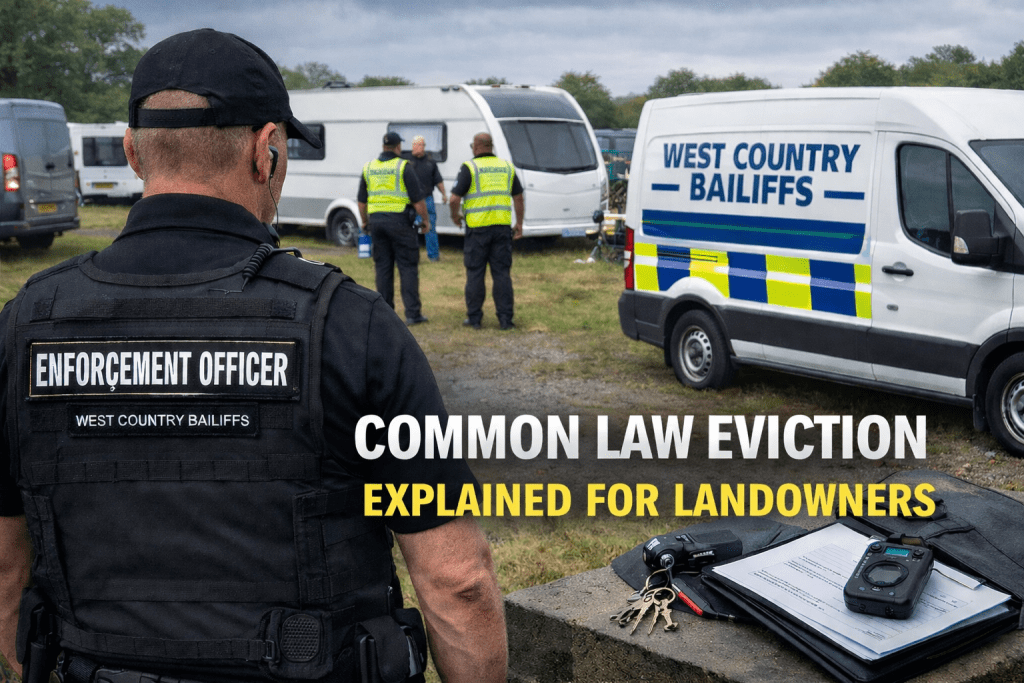
When faced with unauthorised occupation, many landowners ask whether they can take immediate action without going through the courts. This is where common law eviction becomes relevant.
Understanding how common law eviction works, when it applies and how it must be handled is essential if travellers occupy your land. Used correctly, it can provide a lawful and efficient route to regain possession. Used incorrectly, it can expose you to legal risk.
At West Country Bailiffs, we regularly advise landowners on the safest and most effective way to remove travellers from private land, including where common law rights may apply.
What Is Common Law Eviction?
Common law eviction refers to a landowner’s long-established legal right to remove trespassers from private land without first obtaining a court order.
If individuals are occupying land without permission and do not have a tenancy agreement or lawful right to remain, they may be considered trespassers. In certain circumstances, landowners can rely on common law rights to recover possession.
However, the key word is lawful. The process must be proportionate, reasonable and professionally managed.
When Does Common Law Apply?
Common law eviction may be available where:
- The land is privately owned
- There is no tenancy agreement
- The occupants are trespassing
- No statutory protections override the position
- The situation can be managed safely
It is not appropriate in every case. The suitability of this route depends on the specific facts, scale of occupation and potential risk.
A professional assessment is essential before proceeding.
How Common Law Eviction Works in Practice
When travellers occupy private land without consent, enforcement agents may attend the site and formally instruct occupants to leave.
If they refuse, reasonable steps may be taken to remove them and their vehicles from the land. This must be carried out:
- Without excessive force
- Without breaching the peace
- Without causing unnecessary damage
- Without threatening behaviour
Professional enforcement officers understand how to manage this process carefully and lawfully.
In many cases, the presence of experienced enforcement agents is enough to achieve voluntary departure without escalation.
Why Professional Oversight Is Critical
Although common law eviction does not require a court order, it is not a casual process.
Landowners who attempt to remove travellers from private land without professional guidance risk:
- Allegations of harassment
- Claims of unlawful eviction
- Escalation into confrontation
- Reputational damage
- Legal complaints
The difference between lawful recovery and unlawful conduct often lies in how the situation is handled.
Experienced enforcement officers ensure:
- Correct legal footing
- Structured communication
- Calm site management
- Accurate documentation
Professional conduct protects your position.
Common Law vs Court Proceedings
Landowners often ask whether they should use common law eviction or apply for a possession order through the court.
The decision depends on:
- The number of vehicles present
- The urgency of the situation
- The risk of resistance
- Public safety considerations
- Commercial impact
- Site accessibility
Court proceedings provide formal judicial backing. Common law eviction can be faster where appropriate.
If you are unsure which route is suitable, our guide on how to remove travellers from private land quickly and lawfully explains the wider legal framework and available options.
How Quickly Can Common Law Eviction Work?
When appropriate, common law eviction can produce rapid results.
In many cases:
- Enforcement attendance occurs swiftly
- Clear instruction is given
- Occupants depart voluntarily
Speed depends largely on early action. The longer an encampment remains, the more complex it can become.
Delay often increases vehicle numbers and complicates recovery.
Are There Risks Involved?
Every enforcement situation carries some level of risk. That is why proper planning and professional attendance are essential.
Risks may include:
- Escalation of tensions
- Media attention
- Community concerns
- Obstruction of access routes
- Claims of improper conduct
A controlled and proportionate approach significantly reduces these risks.
Documentation and professional communication are key.
When Common Law May Not Be Appropriate
There are situations where common law eviction may not be suitable, including:
- Large encampments
- High risk of confrontation
- Complex access arrangements
- Situations involving vulnerable individuals
- Where court authority provides greater security
In such cases, possession proceedings or alternative legal routes may offer stronger protection.
Choosing the correct method from the outset avoids unnecessary complication.
What Happens After Removal?
Regaining possession is only part of the solution.
Once travellers have left, preventative measures should be considered to reduce the risk of re-entry.
Landowners are often advised to implement:
- Reinforced gate systems
- Physical deterrents
- Barrier controls
- Regular site monitoring
- Rapid response arrangements
Sites that are visibly managed are less likely to be targeted again.
Professional Support Makes the Difference
While common law eviction may sound straightforward, its lawful application requires experience and careful handling.
At West Country Bailiffs, we have over 30 years of enforcement expertise across the South West and nationwide. We assess each case individually, determine whether common law eviction is appropriate and implement the most effective route to remove travellers from private land safely and lawfully.
Our role is not simply to enforce, but to protect your legal position and resolve the matter efficiently.
Taking the Right Action
If travellers occupy your land, do not assume that immediate physical action is the correct response. Seek professional advice first.
A clear legal strategy, proportionate enforcement and structured communication are the foundations of successful land recovery.
For broader guidance on legal routes, timeframes and costs, read our full guide on how to remove travellers from private land quickly and lawfully, or contact West Country Bailiffs for immediate advice tailored to your situation.